
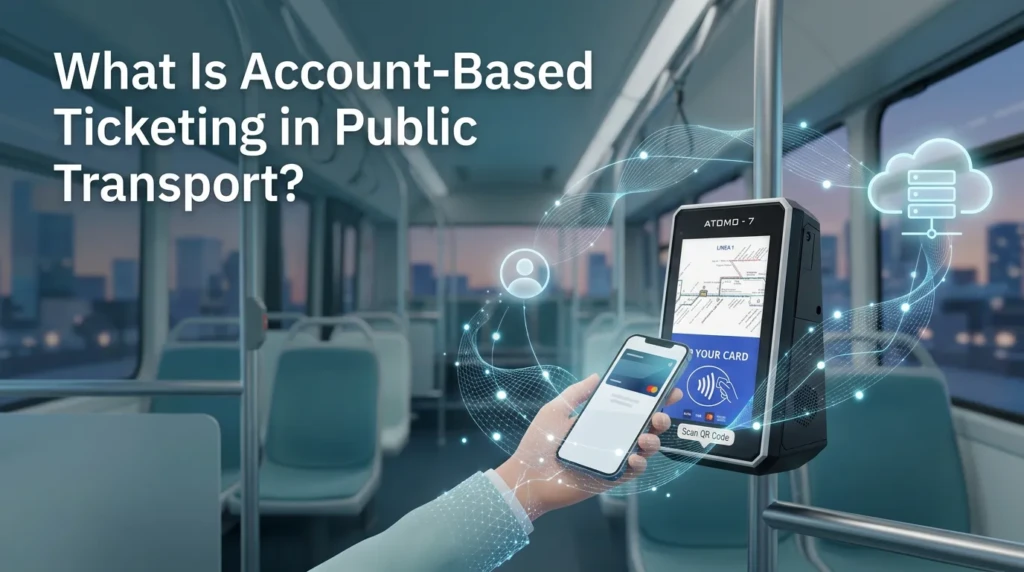
What Is Account-Based Ticketing in Public Transport?
Account-Based Ticketing in Public Transport What It Is and How It Works March 19, 2026 15:05 am Account-based ticketing is one of the most discussed concepts in modern public transport, but it is also one of the most misunderstood. It is often associated with contactless payments, mobile ticketing, and digital fare collection, yet those terms are not interchangeable. In simple terms, account-based ticketing, often shortened to ABT, is a model in which travel rights, fare rules, and transaction logic are managed at account level rather than being fully stored on the passenger’s card or device. This matters because traditional ticketing models often depend heavily on the physical medium itself. In account-based environments, the medium still plays an important role, but it is no longer the only place where value and entitlement are defined. 1. What is account-based ticketing? Account-based ticketing is a ticketing model in which travel rights, travel records, or fare logic are linked to a central account instead of being stored entirely on the travel medium itself. In a card-centric model, a smart card may directly store a pass, stored value, or other entitlement data. In an account-based model, the card, smartphone, QR code, or payment token often acts mainly as an identifier or access medium, while the relevant logic is managed at system level. This does not make the passenger medium irrelevant. It simply changes its role. Instead of carrying all the intelligence on the token itself, the system can manage fare rules, entitlements, and travel events in a more centralized way. If you want a broader overview of how ticketing components work together across a transport network, pair this article with Digitax’s guide to public transport ticketing systems. 👉 Go to Digitax’s guide to public transport ticketing systems. 2. How account-based ticketing works From the passenger perspective, the process is usually straightforward. A traveller presents a card, smartphone, QR code, or payment token when boarding or validating. The system identifies the token, account, or transaction context, records the event, and applies the relevant fare logic at account level rather than relying only on what is physically stored on the medium. In many projects, this allows operators to support more flexible ticketing models over time, especially where multiple media need to coexist. Although ABT is often discussed in back-office or system-architecture terms, real deployments still depend on reliable passenger-facing hardware such as validators, payment terminals, and onboard devices connected to the wider system. For a deeper look at validation media already covered on the site, see Digitax Contactless Validation Technology 👉 See our article Digitax Contactless Validation Technology TABLE of CONTENTS 1. What is account-based ticketing? 1. What is account-based ticketing? 2. How account-based ticketing works 2. How account-based ticketing works 3. ABT vs card-centric ticketing 3. ABT vs card-centric ticketing 4. Is account-based ticketing the same as contactless payment? 4. Is account-based ticketing the same as contactless payment? 5. Why operators move toward ABT 5. Why operators move toward ABT 6. When account-based ticketing makes sense 6. When account-based ticketing makes sense 7. Why operators move toward ABT 7. Why operators move toward ABT 8. What to evaluate before moving to ABT 8. What to evaluate before moving to ABT 9. Conclusion 9. Conclusion FAQ FAQ 3. ABT vs card-centric ticketing The easiest way to understand account-based ticketing is to compare it with a card-centric approach. In a card-centric system, the passenger medium itself usually stores the main travel data. That may include stored value, period passes, concessions, or other travel rights. Updating those rights often means writing directly to the card or device. In an account-based system, the logic is managed centrally. The medium still matters, but it is not the only place where value and entitlement are defined. That difference changes how a system can evolve over time. Card-centric ticketing is often more closely tied to the medium itself. Account-based ticketing is more closely tied to the passenger account and the rules applied around it. This can make ABT more suitable for projects that need: multiple travel media evolving fare policies more flexible rule management gradual modernization from older ticketing environments That does not mean ABT is always the best answer for every project. It simply means it offers a different operating logic. Why this matters in real deployments Account-based ticketing is not just about moving fare logic to a central account.To work well in public transport, it also needs reliable validation, support for multiple media, and passenger-facing devices that can connect smoothly with the wider ticketing environment. 4. Is account-based ticketing the same as contactless payment? No. These two ideas are related, but they are not the same. Contactless payment usually refers to the use of EMV bank cards or digital wallets as payment media. Account-based ticketing refers to the way ticketing logic and travel rights are managed. In many modern deployments, the two work together. A transport environment may support open-loop contactless payments inside a broader ABT model. But ABT should not be treated as a synonym for contactless payment. A useful distinction is this: contactless payment is a payment method account-based ticketing is a ticketing model That is why an ABT environment may support bank cards, transit cards, mobile devices, QR codes, or other media at the same time. Flexible Bus Ticketing Architecture In a modern bus environment, flexible architecture means making validators, onboard terminals and system integrations work together reliably over time. 5. Why operators move toward ABT There is rarely a single reason why operators adopt account-based ticketing. More often, the move is driven by a combination of practical goals, such as: supporting more than one travel medium reducing dependence on a single passenger token enabling more flexible fare policies modernizing older card-centric environments making future system changes easier to manage ABT is therefore not just a technical label. It is often part of a broader modernization strategy in fare collection. 6. When account-based ticketing makes sense ABT is especially relevant when operators want to support a more