
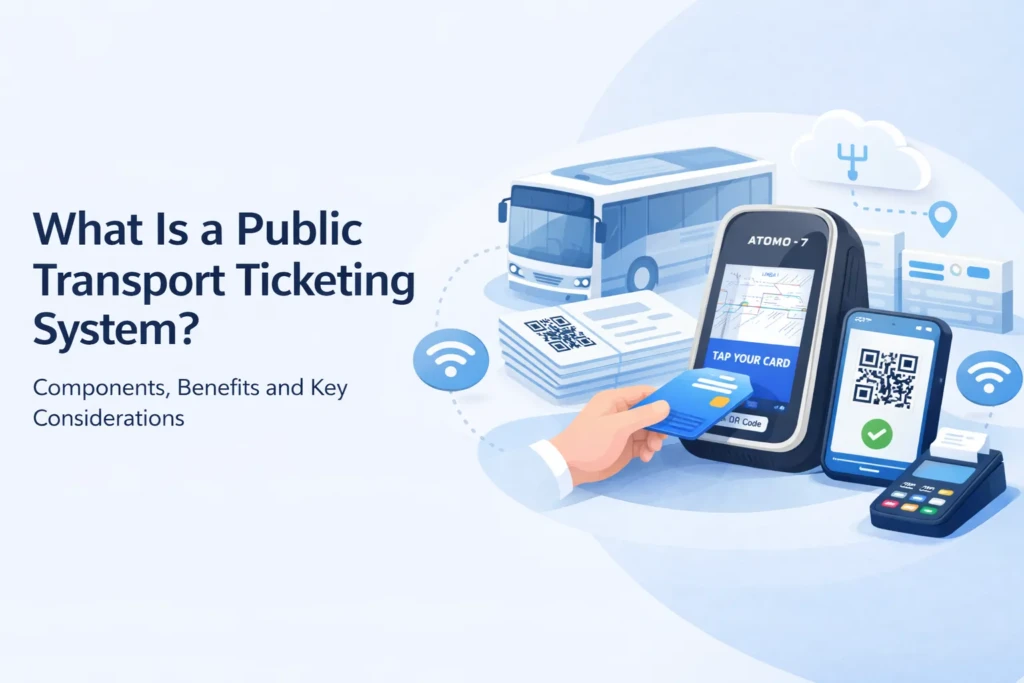
What Is a Public Transport Ticketing System?
What Is a Public Transport Ticketing System? Components, Benefits and Key Considerations March 10, 2026 08:51 am Public transport ticketing has changed significantly over the past decade. What was once a relatively simple process based on paper tickets or closed card systems is now part of a much broader digital ecosystem. Today, a public transport ticketing system often includes validators, onboard terminals, payment technologies, communications infrastructure, and software layers that work together to support both passenger journeys and operator workflows. For transport operators, authorities, and system integrators, understanding how these systems are structured is essential. Choosing the right architecture is not just a question of accepting more payment methods. It is also about reliability, maintainability, interoperability, and long-term upgradeability. 1. What is a public transport ticketing system? A public transport ticketing system is the combination of technologies used to issue, validate, accept, record, and manage travel entitlements across a transport network. In practical terms, it is the system that allows passengers to travel using one or more media such as paper tickets, smart cards, contactless bank cards, QR codes, or mobile devices, while also allowing operators to verify travel rights, collect operational data, and support fare collection processes. A modern ticketing system is rarely a single device or a single software platform. It is usually an ecosystem made up of several connected components, each with a specific role in the passenger journey and the broader transport operation. 2. The main components of a modern public transport ticketing system Passenger-facing validation devices These are the devices passengers interact with directly when boarding or validating a trip. Depending on the deployment, they may support paper ticket validation, smart cards, QR and barcode scanning, NFC-based tickets, contactless EMV payments, and mobile ticketing. In many environments, the validator becomes the most visible part of the ticketing system because it is the point where passenger interaction happens in real time. Onboard terminals and control devices In bus and vehicle-based operations, ticketing is often connected to a wider onboard environment. Mobile Data Terminals and other control devices can support route management, peripheral coordination, communication with validators and printers, and integration with operational systems already installed in the vehicle. This layer matters because a ticketing system does not operate in isolation. In real deployments, it often needs to interact with doors, odometers, passenger counters, printers, vehicle panels, CAN-based information, and other onboard inputs Payment and fare collection technologies A public transport payment system may include different models at the same time, such as closed-loop transit cards, open-loop contactless bank card acceptance, QR-code ticketing, mobile app-based tickets, and account-based ticketing logic in the wider system environment.The best approach depends on the network, passenger habits, fare policy, and existing infrastructure. What matters is that the ticketing environment can support the media and workflows the operator actually needs. Many modern environments also rely on account-based ticketing , where travel rights and fare logic are managed beyond the card or token itself. Connectivity and communications Modern ticketing systems depend on data exchange. Devices need reliable communication for transaction handling, synchronization, remote diagnostics, software and firmware updates, status monitoring, and device management. This becomes especially important in distributed fleets, where uptime and maintainability are just as important as feature sets. Back-office and management layers Although passengers do not see them, back-office layers are essential to the broader system. These can support functions such as fare logic, transaction processing, reporting, operational visibility, and device monitoring. Not every transport project uses the same model, but in most cases the field devices and the software environment must work together in a predictable and interoperable way. For a deeper look at validation media already covered on the site, see Digitax Contactless Validation Technology 👉 See our article Digitax Contactless Validation Technology TABLE of CONTENTS 1. What is a public transport ticketing system? 1. What is a public transport ticketing system? 2. The main components of a modern public transport ticketing system 2. The main components of a modern public transport ticketing system 3. How a public transport ticketing system works in practice 3. How a public transport ticketing system works in practice 4. Why system architecture matters 4. Why system architecture matters 5. What operators should look for in a public transport ticketing system 5. What operators should look for in a public transport ticketing system 6. The role of validators and onboard devices 6. The role of validators and onboard devices 7. A broader view of smart ticketing 7. A broader view of smart ticketing 8. Conclusion 8. Conclusion FAQ FAQ 3. How a public transport ticketing system works in practice From the outside, ticketing can seem simple: a passenger taps a card, scans a code, or presents a digital ticket. In reality, several layers may be involved. A typical journey might look like this: A passenger presents a ticket, card, phone, or payment token. A validator reads the media and checks the required travel data or payment status. The onboard system exchanges information with connected devices or other vehicle-side functions when required. Data is transmitted or synchronized with the wider ticketing environment. The operator receives the transaction and operational information needed for control, reporting, and service continuity. In modern transport environments, this flow is not only about fare collection. It is also linked to passenger throughput, service quality, maintenance efficiency, and long-term system scalability. Why this matters for integrators For integrators, the real challenge is not deploying single devices, but making every part of the ticketing ecosystem work together seamlessly. A modular, interoperable approach helps simplify integration, support future upgrades, and deliver more reliable transport systems for operators and passengers alike. 4. Why system architecture matters Not all ticketing systems are structured in the same way, and this is where many projects succeed or struggle. A well-designed architecture should take into account: the current infrastructure already installed the number and type of onboard devices required accepted media and payment methods communication protocols and interfaces maintenance and replacement workflows upgradeability over time This is especially